Skip to content
No results
  • Home
  • Articles
  • About
  • Contact
Porta Aperta logo
  • Home
  • Articles
  • About
  • Contact
Porta Aperta logo
  • Coatings & Finishes

Smooth Card Finish: Advantages, Tradeoffs, and Common Uses
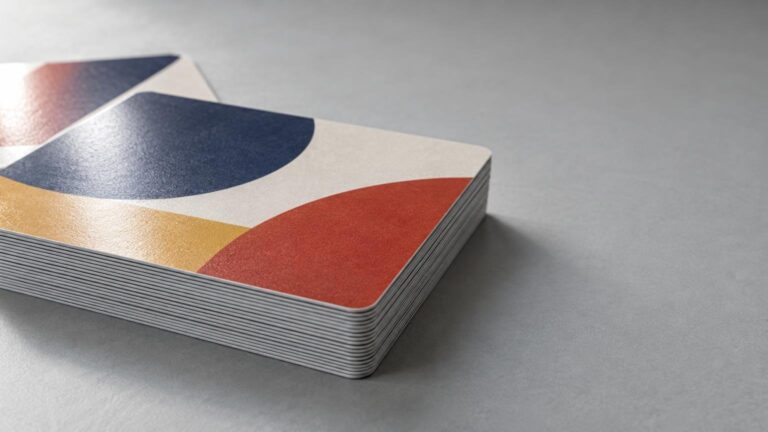
Close-up of a thick stack of rounded-corner cards on a gray surface, with an abstract red, navy, gold, and cream design on the top card and layered paper edges visible along the side.

A smooth card finish can support crisp reproduction and a clean tactile surface, but it does not automatically provide gloss, durability or easy shuffling. Here is how to evaluate the complete construction.
  • Bryce
  • October 30, 2026
  • Coatings & Finishes

Anti-Scratch Coatings for Printed Cards: What They Can and Cannot Do

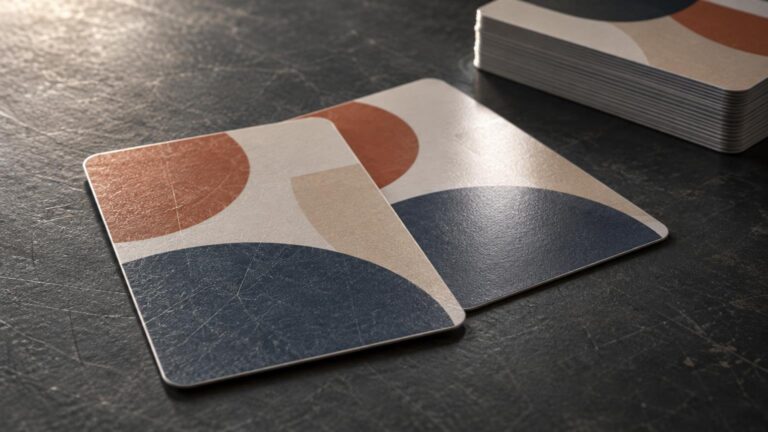
Close-up of two abstract-patterned rounded cards on a dark scratched work surface, with a stacked deck in the background and light reflecting across their textured finish.

Anti-scratch finishes can reduce visible marking, scuffing and ink wear, but they cannot make a printed card immune to damage. The useful specification identifies the type of wear, the complete finish system and the test conditions that matter.

  • Bryce
  • October 25, 2026
  • Coatings & Finishes

Writable Card Coatings: What Makes Ink Stick?

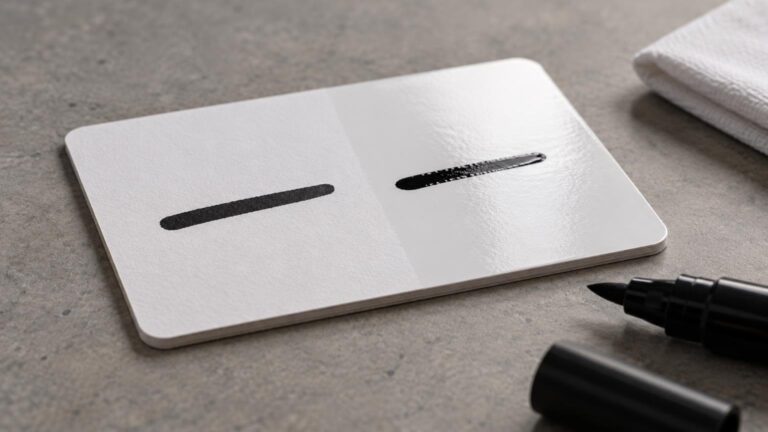
Close-up of a stack of blank white rounded-corner cards with matte and glossy surface areas, each marked with a black ink stroke; an uncapped black marker and folded white cloth sit nearby on a gray work surface.

A card is writable when its exposed surface lets the intended ink wet, deposit and remain in place. Here is how coatings, pen types and production choices affect the result.

  • Bryce
  • October 23, 2026
  • Cutting & Tolerances

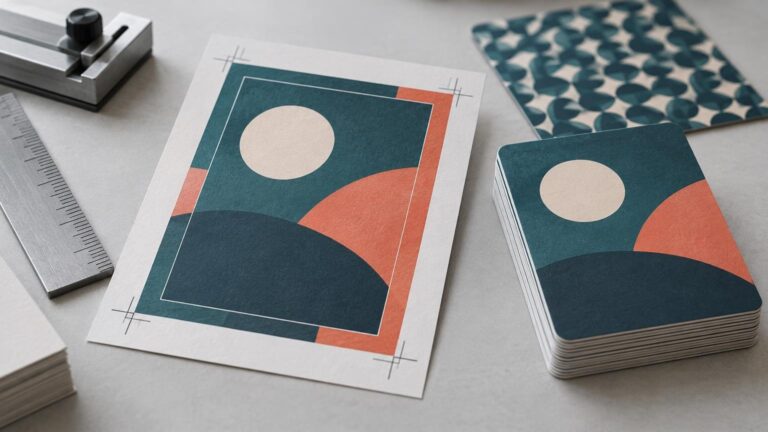
How to Design Custom Cards That Tolerate Normal Trim Variation

Macro workshop scene showing an unbranded geometric card design on a printed sheet with crop and registration marks, beside a stacked deck of matching rounded-corner cards, a metal ruler, and a cutting tool.

Build trim-tolerant custom cards by separating bleed, trim and safe-content zones, then choosing borders, backs and corner details that do not expose small cutting shifts.

  • Bryce
  • October 18, 2026
  • Cutting & Tolerances

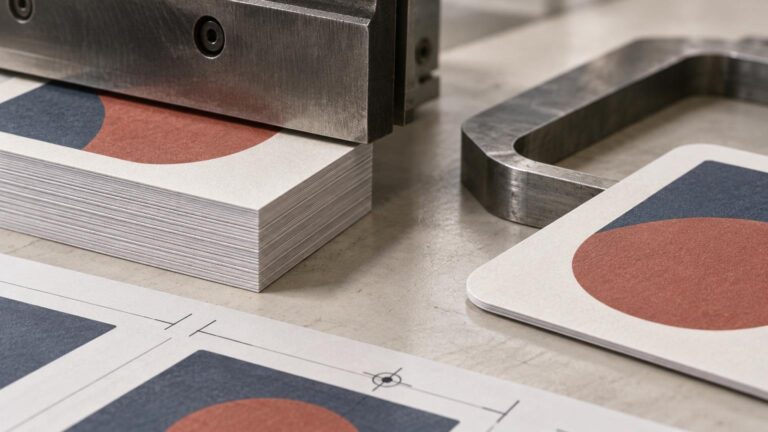
Die Cutting vs Guillotine Cutting for Playing Cards

Close-up of a stack of square-cornered printed card blanks beneath a metal cutting block, beside a rounded rectangular metal die and a stack of rounded-corner cards on a worktable. A printed sheet with registration marks appears in the foreground.

Guillotine cutting produces straight-sided card blanks, while a full-contour die or punch forms the finished perimeter and rounded corners. Learn how each method affects size, registration and deck consistency.

  • Bryce
  • October 16, 2026
  • Cardstock & Construction

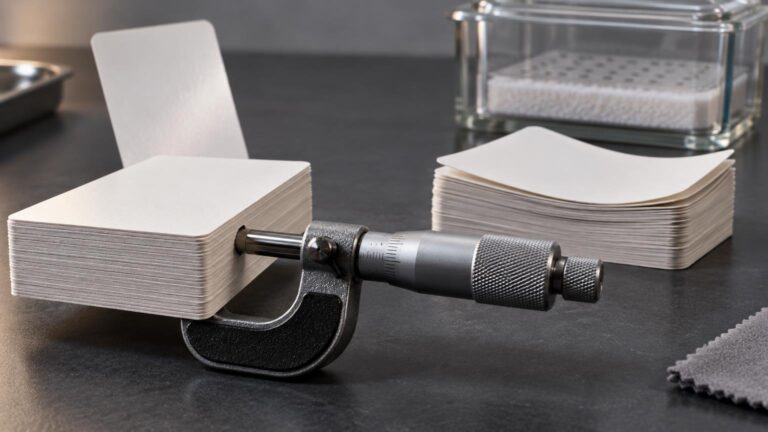
How Humidity Changes Paper Card Thickness and Feel

Close-up of two stacks of blank rounded-corner paper cards on a dark workbench, with a metal micrometer positioned against the edge of the left stack and a small clear container in the background.

Humidity can change a paper card’s dimensions, stiffness, surface behavior and curl. Learn why perceived thickness is not the same as caliper and how to compare cards under controlled conditions.

  • Bryce
  • October 11, 2026
  • Card Production

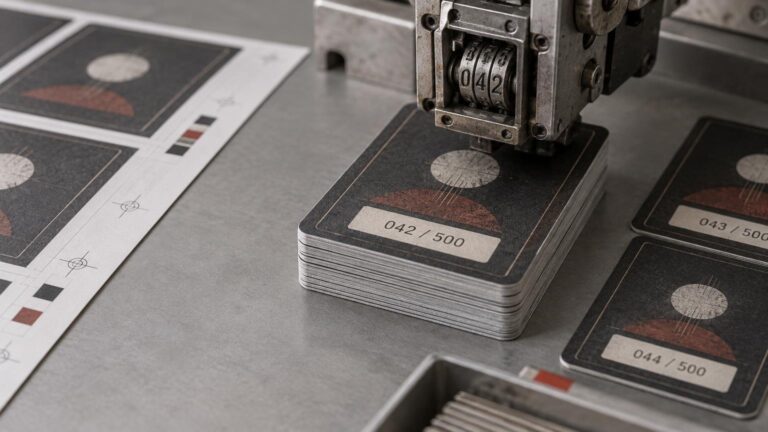
Serial Numbering Custom Cards: Production Methods and Tradeoffs

Macro view of a metal numbering machine above a stack of dark, rounded-corner cards, with adjacent cards labeled “042 / 500,” “043 / 500,” and “044 / 500” beside a printed production sheet with registration marks and color swatches.

Serial numbering is a data, printing and finishing-order problem—not merely a line of artwork. Compare four production routes and learn what to specify before printing.

  • Bryce
  • October 9, 2026
  • Cardstock & Construction

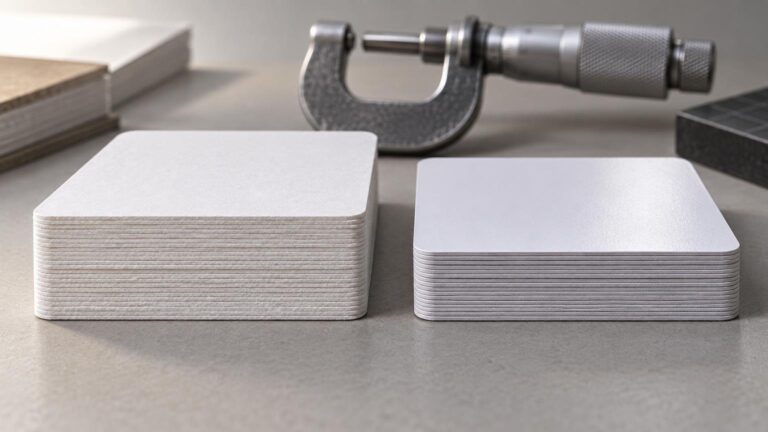
Why Two 300 GSM Cardstocks Can Feel Completely Different

Two stacks of plain rounded-corner white cards of visibly different thickness sit on a gray work surface, with a metal micrometer and additional paper stacks behind them.

GSM measures a sheet’s mass per area, not its thickness, rigidity or surface character. Here is what actually makes equal-weight cardstocks feel different.

  • Bryce
  • October 3, 2026
  • Cardstock & Construction

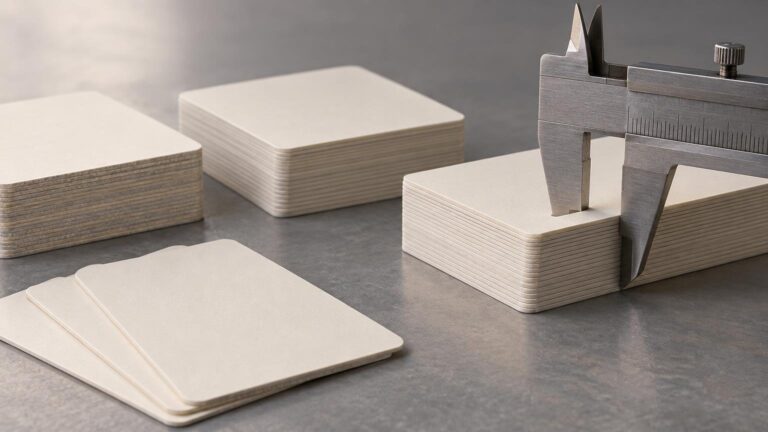
Paperboard Bulk Explained: Why Thickness Is Not the Same as Weight

Macro workshop view of several stacks of blank rounded-corner paperboard cards on a gray surface, with a metal caliper positioned around one stack.

GSM measures mass per area, while caliper measures thickness. Paperboard bulk connects the two, but neither measurement alone predicts stiffness, feel or finished-card performance.

  • Bryce
  • October 2, 2026
  • Cutting & Tolerances

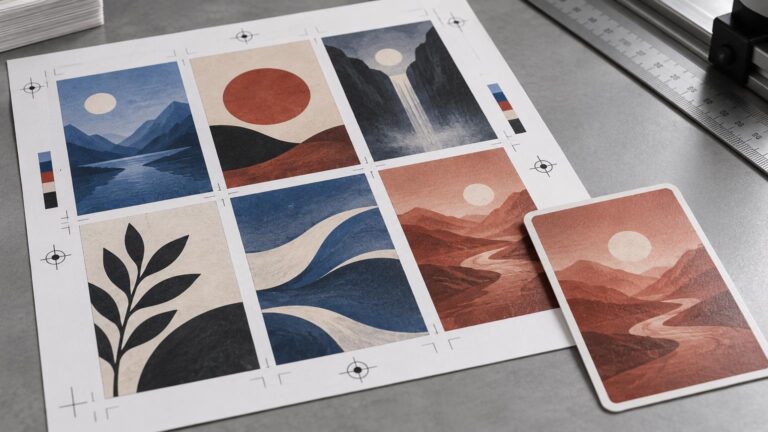
Crop Marks and Registration Marks in Card Production

Macro workshop view of a printed sheet containing six unbranded landscape-art cards, with crop marks, circular registration targets, color bars, a metal ruler, and one trimmed card placed in the foreground.

Crop marks identify the intended trim edge, while registration marks align color separations or help compatible cutting equipment locate a printed sheet. This guide explains how both relate to bleed, safe areas and card-cutting tolerances.

  • Bryce
  • September 26, 2026
1 2 3 4
Next

Who We Are

Explore the construction, coatings, color, cutting and measurements behind well-made physical cards.

contact@porta-aperta.org

Recent Articles

  • Smooth Card Finish: Advantages, Tradeoffs, and Common Uses
  • Anti-Scratch Coatings for Printed Cards: What They Can and Cannot Do
  • Writable Card Coatings: What Makes Ink Stick?
Porta Aperta

Explore the construction, coatings, color, cutting and measurements behind well-made physical cards.

© 2026 Porta Aperta

Information

  • Privacy Policy
  • About Us
  • Contact
  • Editorial Policy
  • All Articles